
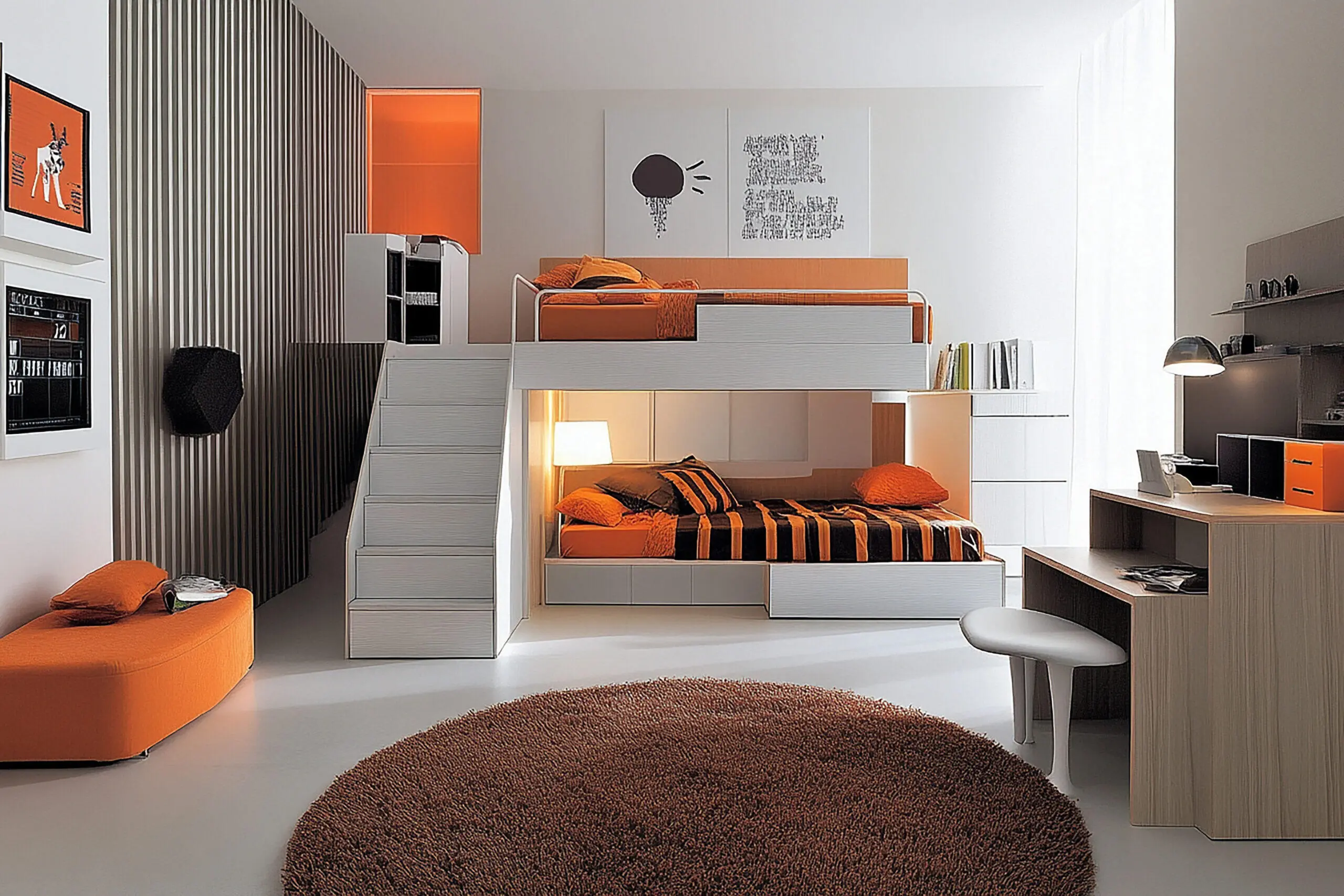
Modern Kids’ Room Design for Two
A modern shared room for two children starts with a symmetrical layout, custom bunk systems, and defined personal zones. Each child should have a distinct visual and functional area, achieved through mirrored furniture, integrated storage, and tailored finishes. This approach ensures both privacy and togetherness in a cohesive space.
The Challenge of Shared Living in Doha
In Doha’s modern residential areas, especially The Pearl and Lusail, families often live in well-finished apartments where space must be used efficiently. Bedrooms are well designed but may not be large enough for each child to have a separate room. For many, sharing is a practical lifestyle choice influenced by community living and long-term planning.
Designing a shared children’s room in Qatar involves more than placing two beds together. Children’s needs vary by age and gender, and even twins benefit from individual identity within a unified design.
The challenge is architectural rather than decorative: dividing space without walls, creating privacy without isolation, and maximizing space while maintaining a refined aesthetic for luxury Doha residences.
At Kidz Casa, we maximize square footage through custom joinery, architectural planning, and efficient spatial flow. Our shared bedrooms are integrated environments where every element, from bed placement to wardrobe depth, is designed to promote harmony, organization, and comfort.
In high-rise apartments in The Pearl and Lusail, space efficiency must match sophistication. Parents expect clean lines and premium materials, while children need storage, creativity, and a sense of belonging. Our goal is to meet both needs seamlessly.
Modern Layout Strategies for Shared Bedrooms
Designing a room for two children centers on layout. The chosen configuration affects available play space, storage integration, and the room’s adaptability as children grow.
Here are three effective high-end layout strategies we use in Doha homes.


1. The Symmetrical Split: Balanced and Harmonious
This layout is particularly effective for twins or siblings close in age.
Two identical beds are placed opposite or parallel along one wall, with a central shared element such as a bedside tower, bookcase, or custom storage column anchoring the room.
Why It Works:
- Creates visual harmony and emotional fairness.
- Eliminates “territorial competition.”
- Simplifies furniture selection.
- Supports long-term adaptability as children grow.
Key Design Enhancements:
- A central joinery unit with dual-access drawers.
- Mirrored headboards in complementary finishes.
- Wall paneling that visually divides each side.
- Coordinated yet distinct bedding palettes.
In Doha apartments, where walls are typically straight and rectangular, symmetry maintains architectural clarity and complements the modern styles found in Lusail and The Pearl.
The symmetrical split is especially suitable when:
- The room is medium-sized.
- Ceiling height is standard.
- Both children are similar in age.
- Parents prefer a calm, hotel-like aesthetic.
Custom joinery elevates this layout from basic to architectural.
2. L-Shaped Corner Beds: Maximum Play Area
For smaller bedrooms, placing beds in adjacent corners significantly changes the perception of space.
In this layout, beds form an L-shape in separate corners, freeing up central floor space.
Why It Works:
- Opens the center of the room for play.
- Allows visual separation without walls.
- Encourages creative zoning.
- Works well in square-shaped rooms.
Design Strategies:
- Install built-in under-bed drawers.
- Use vertical shelving above each bed.
- Incorporate corner wardrobes to utilize depth.
- Add a central rug to define shared play space.
This configuration is ideal for The Pearl apartments, where bedrooms are not large but benefit from geometric layouts.
We often enhance this design with:
- Floating desks along the remaining wall.
- Corner reading nooks.
- Integrated wall lighting to eliminate bulky lamps.
Using corners effectively increases usable floor area, which is essential for growing children.
3. The Custom Loft / Bunk System: Vertical Intelligence
Doha’s generous ceiling heights allow for vertical expansion.
A custom loft or bunk system can transform an entire wall into an integrated architectural feature that includes:
- Two beds (stacked or lofted)
- Two desks
- Wardrobe storage
- Open shelving
- Drawers and concealed compartments
Why It Works:
- Maximizes limited floor area.
- Consolidates functions into one wall.
- Provides privacy within the structure.
- Feels modern and custom-built.
Kidz Casa integrated systems are tailored to each room’s exact dimensions, unlike standard bunk beds. We consider:
- Safe ladder access.
- Guardrail height compliance.
- Lighting integration.
- Desk ergonomics.
- Air circulation.
For older children, loft beds with desks underneath create individual workspaces within one room, allowing autonomy while maintaining shared space.
This is particularly effective in:
- Compact Lusail apartments.
- Rooms with higher ceilings.
- Siblings of different ages.
- Families seeking long-term functionality.
Properly designed vertical systems maximize space without feeling crowded.
Creating Individual Identity Within One Room
Even in symmetrical or integrated layouts, it is important to highlight each child’s individuality.
Children need a sense of ownership. A shared room should feel like two personalized spaces within a unified design.
Here are professional strategies we use to personalize each zone:
- Customized headboards featuring the child’s name, favorite color, or subtle motif.
- Individual niche lighting is integrated into wall panels for each bed.
- Personalized shelving above each desk or sleeping area.
- Divided wardrobes with color-coded handles or subtle internal markers.
- Unique bedding textures while maintaining overall palette cohesion.
- Custom pinboards or magnetic walls for artwork.
- Privacy curtains for bunk systems.
- Acoustic wall panels to dampen sound.
- Separate desk drawers with labeled compartments.
- Individual reading lights with adjustable brightness control.
For a boy and a girl sharing a room, we recommend a unified base color scheme, such as soft neutrals or warm greys, and personalized accents like sage on one side and blush on the other.
Cohesion should come first, with personality expressed through details.
The Expert Comparison Table
| Play Area Gained | Minimal | Significant floor space freed through vertical and corner planning |
| Storage Capacity | Limited to bedside tables | Full-height wardrobes, under-bed drawers, integrated shelving |
| Privacy Levels | Low visual separation | Defined zones, acoustic elements, structured dividers |
| Aesthetic Flow | Furniture-heavy, disconnected | Seamless architectural integration |
| Long-Term Adaptability | Requires furniture replacement | Designed to evolve with child’s age |
| Visual Harmony | Often mismatched | Cohesive, custom-tailored design |
The distinction lies in spatial intelligence, not just aesthetics.
Designing for Age Differences
Shared bedrooms become more complex when siblings differ significantly in age.
For example:
- A toddler and a 10-year-old.
- A teenager and a primary student.
- A boy and a girl are approaching adolescence.
In these cases, zoning is more about psychological boundaries than physical ones.
Solutions include:
- Lofting the older child’s bed to create a defined territory.
- Using subtle room dividers, such as vertical slats.
- Installing sliding panels that can be opened or closed.
- Differentiating study areas from play areas.
- Incorporating flexible lighting systems.
A well-designed shared room adapts as children grow.
The Unsung Hero of Shared Bedrooms
Lighting is often overlooked in shared rooms.
In Doha, apartments with limited natural light in secondary bedrooms require strategically layered artificial lighting.
We recommend:
- Ambient ceiling lighting.
- Task lighting at each desk.
- Individual bedside reading lights.
- Indirect LED strips under shelves.
- Motion-sensor wardrobe lighting.
Whenever possible, each child should control their own light source. This autonomy supports harmony.
Storage as the Foundation of Harmony
Clutter can lead to conflict.
When two children share a room, storage needs increase and must be designed intelligently.
Essential storage strategies:
- Full-height wardrobes with internal division.
- Pull-out toy bins.
- Under-bed drawers.
- Overhead cabinetry.
- Integrated study storage.
- Hidden compartments for seasonal items.
In Doha homes, where seasonal wardrobes vary, storage planning must account for changing volume.
Custom joinery enables us to design for lifestyle as well as dimensions.
FAQ
1. How do you design a shared room for a boy and a girl?
Use a neutral base palette and personalize through accents, textiles, and lighting. Maintain symmetry while allowing subtle individuality. Privacy elements such as vertical panels or loft zoning help as children grow older.
2. What is the best way to divide a small shared room in a Doha apartment?
Use architectural elements instead of furniture. Consider loft systems, L-shaped beds, or integrated wardrobes that act as subtle dividers without reducing floor area.
3. Are bunk beds safe for children?
Custom-designed bunk systems built to precise measurements and safety standards are completely safe. Guardrails, ladder angles, and structural stability are essential.
4. How can I maximize storage in a shared bedroom?
Invest in full-height custom joinery, under-bed drawers, overhead cabinets, and integrated desks. Avoid freestanding furniture that wastes vertical space.
5. What if the children have different ages?
Create distinct zones using layout and lighting. Older children benefit from elevated beds or semi-private study areas.
6. How do I ensure fairness between siblings?
Symmetry in layout and storage distribution is key. Equal wardrobe sections and identical bed sizes prevent imbalance.
7. Is it better to choose identical beds?
For younger children or twins, yes. For different ages, variation may be appropriate—but balance must remain.
8. How can privacy be improved in shared rooms?
Incorporate curtains, acoustic panels, vertical slats, or loft structures that subtly separate space.
9. How do you maintain a modern aesthetic in kids’ rooms?
Use clean lines, concealed storage, neutral palettes, and custom-built solutions rather than themed furniture.
10. Can a shared room feel luxurious?
Absolutely. When treated as an architectural project with bespoke joinery, premium finishes, and intentional layout, a shared room can be as refined as a master suite.
Final Thoughts
Designing a shared bedroom in Doha is about intelligent architecture, not compromise. When privacy and togetherness are balanced through thoughtful layout, vertical planning, and personalized zones, children thrive.
Each shared room requires a tailored architectural solution. Kidz Casa provides specialized site visits in Doha to measure your space and develop a 3D plan that meets your children’s needs. Contact us today for a consultation.

Add a comment